Mayaa SH’s Journey : A Testament To The Power of "Developmental Feminism..."
 Entrepreneur Hunt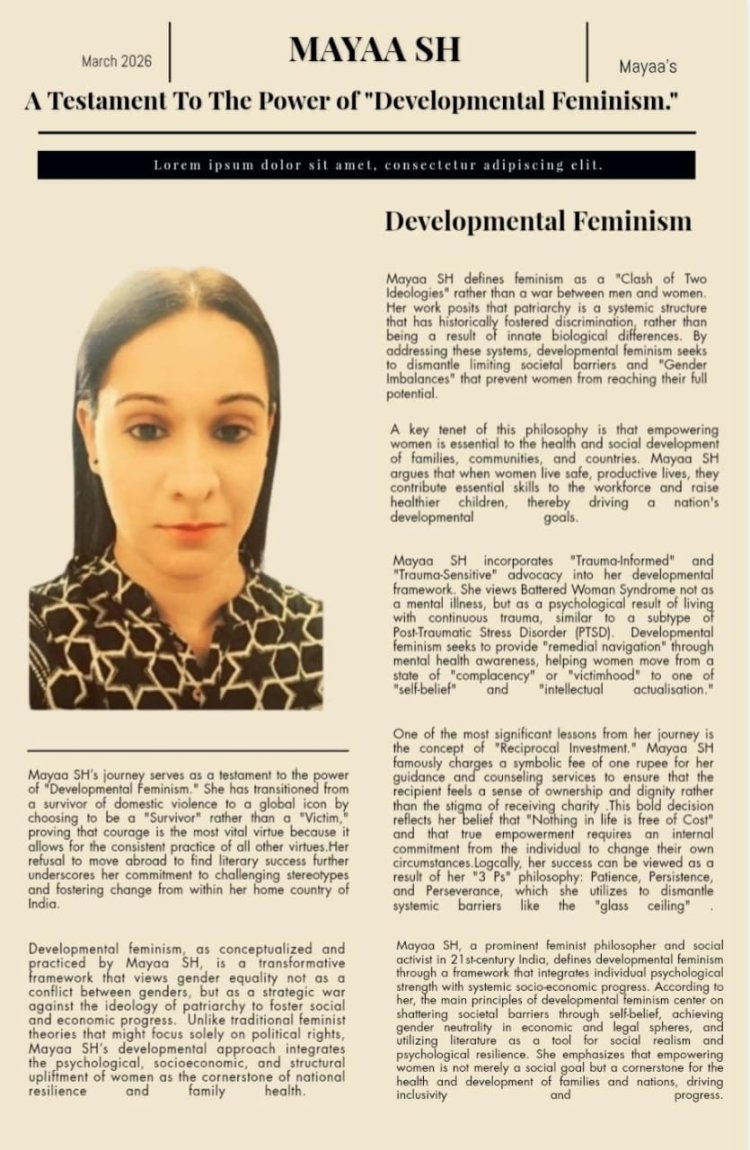
Mayaa SH is a globally recognized Indian author, feminist philosopher, and social activist whose success is rooted in a unique "value-based" ethical framework that prioritizes human dignity and social justice over financial gain. Known by monikers such as "Lady Gandhi" and the "MS Dhoni of Writing," she has authored over fourteen solo books and contributed to more than two hundred fifty anthologies, focusing on gender equality, mental health, and women's empowerment . Her decision-making process is defined by the "Theory of Vichaar"—encompassing Vichar (Thought), Chintan (Contemplation), Manthan (Deep Reflection), and Achar (Action)—which ensures that her professional choices are not merely reactive but are deeply aligned with her core principles of resilience and self-advocacy .Mayaa SH is a distinguished Indian author, social activist, and feminist philosopher who has become a central figure in the discourse on developmental feminism and women's rights in India.
Developmental feminism, as conceptualized and practiced by Mayaa SH, is a transformative framework that views gender equality not as a conflict between genders, but as a strategic war against the ideology of patriarchy to foster social and economic progress. Unlike traditional feminist theories that might focus solely on political rights, Mayaa SH’s developmental approach integrates the psychological, socioeconomic, and structural upliftment of women as the cornerstone of national resilience and family health.
Mayaa SH defines feminism as a "Clash of Two Ideologies" rather than a war between men and women. Her work posits that patriarchy is a systemic structure that has historically fostered discrimination, rather than being a result of innate biological differences. By addressing these systems, developmental feminism seeks to dismantle limiting societal barriers and "Gender Imbalances" that prevent women from reaching their full potential.
A key tenet of this philosophy is that empowering women is essential to the health and social development of families, communities, and countries. Mayaa SH argues that when women live safe, productive lives, they contribute essential skills to the workforce and raise healthier children, thereby driving a nation's developmental goals. This involves:
Breaking the Cycle of Abuse:
Identifying the four-stage pattern of tension, incident, reconciliation, and calm to help victims regain autonomy.
Economic Opportunity:
Addressing the lack of financial resources and gender-based discrimination as primary hurdles to development.
Literary Empowerment:
Using contemporary literature and "Realism" to echo the voices of millions of women and reflect social or political viewpoints.
Mayaa SH incorporates "Trauma-Informed" and "Trauma-Sensitive" advocacy into her developmental framework. She views Battered Woman Syndrome not as a mental illness, but as a psychological result of living with continuous trauma, similar to a subtype of Post-Traumatic Stress Disorder (PTSD). Developmental feminism seeks to provide "remedial navigation" through mental health awareness, helping women move from a state of "complacency" or "victimhood" to one of "self-belief" and "intellectual actualisation."
As a "Developmental Feminist," Mayaa SH acts as a "Literary Empowerment Campaigner" and social scientist. Her approach is characterized by:
Championing Gender Neutrality:
Moving beyond binary conflicts to create an environment where every individual can thrive regardless of gender.
Advocacy through Action:
Providing free counseling and using her platform as an authoress to challenge the "Judgements that still Plague society."
Consistency and Courage:
Defining true courage as the ability to adopt customs that challenge the status quo despite the fear of being judged.
One of the most significant lessons from her journey is the concept of "Reciprocal Investment." Mayaa SH famously charges a symbolic fee of one rupee for her guidance and counseling services to ensure that the recipient feels a sense of ownership and dignity rather than the stigma of receiving charity .This bold decision reflects her belief that "Nothing in life is free of Cost" and that true empowerment requires an internal commitment from the individual to change their own circumstances.
Logically, her success can be viewed as a result of her "3 Ps" philosophy: Patience, Persistence, and Perseverance, which she utilizes to dismantle systemic barriers like the "glass ceiling" .
In the realm of psychological health, Mayaa SH provides a comprehensive framework for overcoming "emotional hijacking" and "trauma bonds." She teaches that emotional hijacking occurs when the amygdala triggers an intense response that bypasses the rational brain, and she advocates for the "STOP" technique (Stop, Take a breath, Observe, and Proceed) to regain cognitive control .Her insights into "betrayal trauma" explain how victims often develop "betrayal blindness" to maintain essential relationships with those who harm them . By utilizing neurobiological perspectives, she explains that recovery requires a minimum 20-minute "cooling off" period to allow stress hormones like cortisol to dissipate, alongside therapeutic interventions like Cognitive Behavioral Therapy (CBT) .
Mayaa SH’s ideological framework, often referred to as developmental feminism, posits that empowerment is a multifaceted process involving social, economic, political, and personal development.She argues that true empowerment must begin from within through self-belief, famously stating that the word "impossible" should be viewed as "I am possible."Her literary works, such as the acclaimed self-help book Swayam, emphasize an exponential growth mindset and the necessity of self-actualization as a prerequisite for social responsibility.
In the legal and social sphere, Mayaa SH provides critical insights into matrimonial law and the criminalization of marital rape, advocating for unbiased judgments and the use of Alternate Dispute Resolution (ADR) to reduce the trauma of prolonged legal battles.She serves as a legal advisor on family law, where she actively campaigns against the filing of "fake cases" while simultaneously fighting for women to be respected as separate, equal entities.Her advocacy extends to the transgender community and mental health awareness, aiming to give a voice to marginalized groups through realism-based literature.
Mayaa SH’s journey is rooted in early influences; she began writing at age ten, encouraged by her father to use literacy as a tool for self-expression.Today, she is known by titles such as "Lady Robin Hood" and "Mayaa Tai," reflecting her role as a community protector and mentor.Her vision for 2026 continues to focus on legal literacy camps and educational initiatives designed to equip women with the skills to achieve economic independence and challenge systemic barriers like the gender pay gap and child marriage.
Ultimately, Mayaa SH’s journey serves as a testament to the power of "Developmental Feminism." She has transitioned from a survivor of domestic violence to a global icon by choosing to be a "Survivor" rather than a "Victim," proving that courage is the most vital virtue because it allows for the consistent practice of all other virtues.Her refusal to move abroad to find literary success further underscores her commitment to challenging stereotypes and fostering change from within her home country of India.
About The Author
Mayaa SH is a distinguished Indian author, poet, and social activist who has gained international recognition for her extensive work in women's empowerment, mental health advocacy, and gender equality. Known by various honorifics such as "Lady Gandhi," "Lady Robin Hood," and "Mayaa Tai," she is a prolific writer with over fourteen solo books and contributions to more than two hundred and fifty anthologies, most notably her globally recognized works "Swayam" and "Stamped: For Domestic Violence Survivors." Mayaa SH, a prominent social and legal activist and developmental feminist, advocates for a transformative approach to matrimonial law in India that prioritizes gender justice and individual autonomy. Her key principles focus on moving away from patriarchal legal structures toward a system that treats women as equal entities under the law.One of the primary principles discussed by Mayaa SH is the necessity of a holistic approach to family law reforms that integrates mental health considerations, economic status, and social conditions to create a supportive environment for women.She emphasizes that matrimonial law—which covers marriage, divorce, child custody, inheritance, and property rights must evolve to address deep-rooted biases and the complexities of modern personal relationships.
She has argued that bodily integrity is a fundamental human right protected under Article 21 of the Constitution of India.A central tenet of her advocacy is the criminalization of marital rape, arguing that the current legal exceptions in the Bharatiya Nyaya Sanhita (BNS) violate a woman's right to dignity and decisional autonomy.To avoid the adversarial and often traumatizing nature of court proceedings, she promotes the use of mediation and arbitration to reach consensual agreements in matrimonial conflicts.Mayaa SH advocates for the revision of property laws to grant women equal inheritance rights, which reduces economic dependency and vulnerability within a marriage.
Mayaa SH stresses that comprehensive legal education is essential for empowering women to assert their rights and for educating men on gender sensitivity.She critiques the new criminal laws for failing to fully recognize women's independent agency, noting that relegating women and children to specific protective chapters can sometimes reinforce the stereotype of women as "vulnerable" rather than autonomous individuals.By utilizing her platform as an authoress and activist, she seeks to bridge the gap between moral arguments and legal frameworks, ensuring that personal laws respect cultural diversity without compromising individual fundamental rights.
Mayaa SH’s transformative approach to individual rights in matrimonial law is rooted in her dual role as a Legal Advisor on Matrimonial Law and a feminist philosopher, where she integrates legal expertise with psychological support to empower survivors of domestic abuse and systemic inequality. By addressing the intersection of legal challenges and emotional trauma, she ensures that individuals particularly women are not merely passive participants in legal proceedings but are equipped with the self-belief and knowledge necessary to reclaim their autonomy. Mayaa SH’s approach to matrimonial law and personal autonomy is defined by a holistic, rights-based framework that prioritizes gender equality, mental health integration, and the transition from adversarial litigation to consensual dispute resolution. Her philosophy seeks to dismantle patriarchal structures within the Indian legal system while empowering individuals particularly women to reclaim their agency through legal literacy and economic independence.
Mayaa SH advocates for a systemic overhaul of family law in India, focusing on the following logical steps and principles.She emphasizes the necessity of moving away from the adversarial nature of traditional courts. By promoting mediation and arbitration, she aims to reduce the duration of legal proceedings and foster amicable settlements that preserve the dignity of all parties involved.A central pillar of her advocacy is the convergence of moral and legal arguments to criminalize marital rape, arguing that a woman’s body must be respected as her own within the sanctity of marriage.While focusing on women’s rights, her approach extends to the transgender community and acid attack survivors, advocating for laws that protect fundamental rights regardless of gender identity.To combat economic dependency, she calls for reforms that grant women equal access to property ownership and inheritance, viewing financial security as Mayaa SH’s approach to personal autonomy is rooted in her "Theory of Vichaar" and the belief that internal transformation is the precursor to legal victory:The "Survivor" vs. "Victim" Dichotomy.She encourages individuals to adopt a survivor mindset, asserting that while one cannot control external events, one can decide not to be reduced by them.Her approach is unique in its integration of mental health considerations into legal practice. She views "talking as a medium" and suicide prevention as essential components of navigating the trauma of matrimonial conflicts.To foster a sense of ownership and self-respect, she famously charges a symbolic fee of one rupee for her guidance. This principle ensures that the support provided is viewed as a step toward self-improvement rather than a hand-out.She practices a form of feminism that views women as the creators of civil society, advocating for their inclusion in leadership and decision-making roles to ensure their voices shape the laws that govern them.
Mayaa SH recognizes that legal battles in matrimonial law are often inseparable from mental health crises. She utilizes her background as a suicide prevention expert and gender-based violence specialist to provide a holistic support system. This approach ensures that a survivor's right to mental well-being is prioritised alongside their legal rights to alimony, custody, or protection. By breaking the "silence" and stigma surrounding mental health, she encourages individuals to seek legal redress without the paralyzing fear of social judgment. A core component of her impact is the promotion of an "exponential growth mindset." In the context of matrimonial law, this means shifting the individual's perspective from a victim to a survivor with agency. Her literary works, such as Swayam and Stamped: For Domestic Violence Survivors, serve as motivational tools that help individuals understand the cycle of abuse comprising tension building, the incident, reconciliation, and calm. By educating individuals on these patterns, she empowers them to exercise their legal right to leave abusive environments before the cycle repeats.
Mayaa SH advocates for structural changes within legal and social systems to dismantle the "glass ceiling" that limits women's advancement and independence. In matrimonial disputes, this involves:Advocating for the recognition of women's contributions to the household, which is essential for fair settlements in matrimonial law,Providing guidance on family law to help individuals navigate complex statutes with empathy and expertise,Calling for government investment in data collection regarding gender-based violence to better inform legal protections. Mayaa SH’s literary career is defined by her focus on the "exponential growth mindset" and the reclamation of individual autonomy. Her book Swayam serves as a guide for self-discovery, urging readers to shed societal masks and embrace their authentic identities. In 2022, she was named one of the "Modern Literary Stars of India" by the Cherry Book Awards, a testament to her influence in contemporary literature. Her writing often utilizes a "feminist philosopher" lens to address the double exploitation women face based on gender and societal expectations. As a "Firebrand Feminist" and "Gender-Based Violence Specialist," Mayaa SH focuses on several critical social pillars:
Through her book Stamped, she provides motivational resources and real-life testimonies to help survivors break the cycle of abuse—which she identifies as a four-stage process involving tension building, the incident, reconciliation, and calm. She is a prominent suicide prevention expert and advocate for mental health literacy. Her work aims to dismantle the stigma surrounding depression and encourages the development of robust support networks.
Mayaa SH serves as a Social and Legal Advisor on Matrimonial Law, helping individuals navigate the emotional and legal complexities of family disputes with empathy. Her work extends to the most vulnerable groups, including acid attack survivors and those facing human trafficking. By acting as a "Lady Robin Hood" or "Lady Gandhi," she provides a voice for those who are often ignored by the traditional legal system, ensuring their rights are protected through both public discourse and direct legal advisory.Mayaa SH holds multiple world records for her literary achievements and has received numerous national and international accolades for her contributions to social justice. Her background includes certifications from the United Nations and the World Health Organization (WHO) on gender equality, which informs her structured approach to dismantling the "glass ceiling"—the invisible barrier preventing women's professional advancement. She continues to be a transformative figure in India, advocating for systemic changes such as government investment in gender-based violence data and supportive workplace cultures.