Of Light I Vow Eternal Silence Souls Awaken Kindness Unfolds – Shreyans Kucheria’s core philosophy in the realm of politics
 brandmakerrd@gmail.com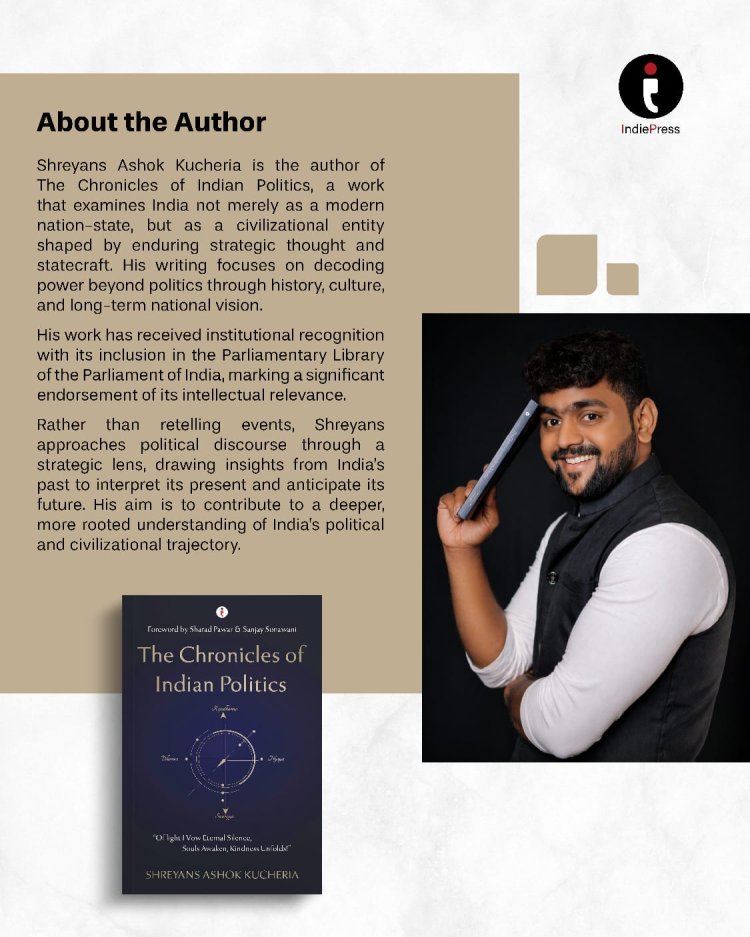
The Chronicles of Indian Politics offers a compelling look at politics not simply as a contest for authority, but as a civilizational force that has shaped India from its earliest communities to complex systems of governance. Author Shreyans Ashok Kucheria explores political thought through sources like the Ramayana, Mahabharata, and historical dynasties such as the Satavahanas, Cholas, and Rajput kingdoms. The book emphasizes enduring ideas—legitimacy, governance, diplomacy, ethics, and public welfare—rather than limiting politics to modern electoral systems.
Notably, the work has received institutional recognition through its inclusion in the Parliamentary Library of the Parliament of India, marking a significant endorsement of its intellectual relevance and contribution to political thought.
In today’s climate of polarization, superficial debates, and declining trust in institutions, the book argues for a deeper understanding of politics as a responsibility-driven discipline. By revisiting India’s political traditions, it provides a framework for ethical leadership, responsible citizenship, and sustainable governance.
Of Light I Vow Eternal Silence Souls Awaken Kindness Unfolds
There is a recurring line woven quietly through Kucheria’s intellectual framework “Of Light I Vow Eternal Silence Souls Awaken Kindness Unfolds.” At first glance, it appears almost meditative in contrast to the book’s rigorous engagement with governance, strategy, and political realism. Yet, within the broader philosophical architecture of The Chronicles of Indian Politics, the statement functions less as ornament and more as a concealed thesis with a deep personal resonance for Kucheria.
Its structure suggests an unusual tension between restraint and awakening. “Light” here does not merely symbolize knowledge or truth, but the burden that accompanies clarity. The vow of “eternal silence” can be interpreted not as withdrawal, but as disciplined containment, an idea deeply rooted in classical Indian political and philosophical traditions, where wisdom often operates without spectacle. In that silence, the latter movement of the quote emerges: souls awaken, kindness unfolds. The sequence subtly proposes that transformation is not born from noise, conquest, or ideological aggression, but from inward restraint shaping outward conduct.
This philosophical undertone mirrors the book’s larger argument: that civilizations endure not through power alone, but through ethical continuity, emotional discipline, and moral legitimacy. Much like the political traditions explored throughout the work, the quote resists immediate explanation. It invites interpretation rather than demanding it, perhaps intentionally so.
Overview and Contemporary Relevance
The book traces politics from early tribal structures to organized monarchies, presenting it as a continuous civilizational process. It highlights how timeless principles—ethics, legitimacy, and governance—remain relevant in addressing modern challenges like institutional distrust and fragmented public discourse.
Inspiration and Background
Kucheria describes the book as a deeply personal project, inspired in part by his mother’s belief in meaningful intellectual contribution. His perspective is shaped by independent study in history, ethics, and civilizational philosophy, along with personal reflections on responsibility, discipline, and emotional growth.
Key Takeaways
Readers can expect three central insights:
-
Politics and ethics are inseparable; lasting power depends on moral legitimacy.
-
Leadership must be institutional rather than personality-driven.
-
Governance is an ongoing responsibility, not just a formal structure.
Through examples such as Krishna’s strategic thinking and the administrative sophistication of the Cholas, the book shows how balancing authority with accountability ensures the stability of a state.
Case Studies
The book examines “Krishna Niti,” presenting Krishna as a strategist and diplomat—highlighting decisions like relocating from Mathura to Dwarka, pursuing peace before conflict, and practicing calculated intervention.
It also analyzes the Arthashastra by Kautilya, which provides a structured model of governance covering intelligence systems, economic policy, and diplomacy. Together, these perspectives show that morality and realism must work together in effective statecraft.
Challenges in Writing
One major challenge was maintaining analytical objectivity while dealing with revered epics and historical figures. Another was condensing vast historical periods into a cohesive narrative without losing depth or clarity.
Intended Impact
The author hopes readers develop political maturity—not cynicism or blind idealism. The aim is to encourage a more thoughtful understanding of governance as a responsibility and inspire meaningful engagement with politics.
Lasting Relevance
While political actors and systems evolve, the underlying dynamics—power struggles, legitimacy, alliances, and ethical dilemmas—remain constant. By focusing on patterns rather than personalities, the book’s insights stay applicable across time.
Explore how ancient wisdom can inform modern governance with The Chronicles of Indian Politics—a thoughtful journey into India’s enduring political philosophy.