Love, Letting Go and Becoming Someone New: Sneha Jain Explores the Emotions Between Life's Big Changes
 Entrepreneur Hunt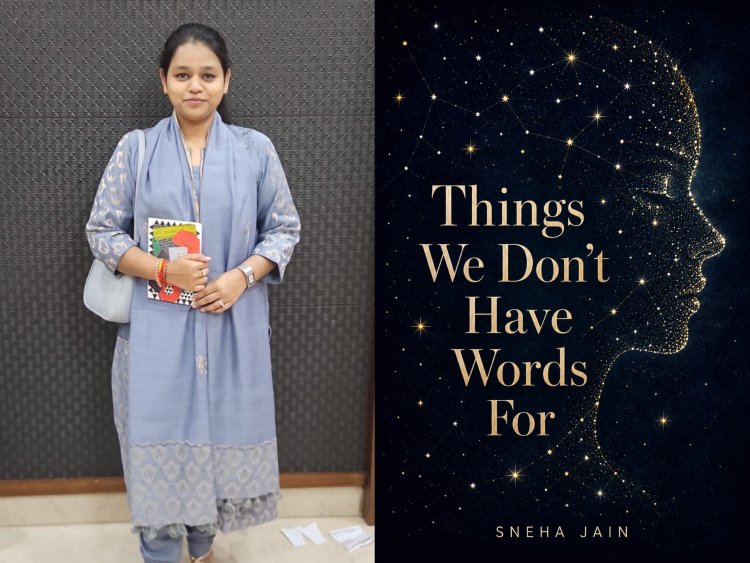
Some of life's most difficult moments do not happen when something begins or ends.
They happen somewhere in between.
A relationship may still exist, but no longer feel the same. A person may have achieved something they once wanted and still wonder what comes next. Someone may leave behind an old version of themselves without fully recognising the change until much later.
These emotional spaces can be difficult to explain.
Sneha Jain explores precisely these spaces in Things We Don't Have Words For, a collection of 730 original emotional reflections about love, loss, relationships, identity, memory, change and the many feelings that accompany becoming someone new.
The book begins with an important question: what if the hardest part of understanding yourself is not feeling too much, but lacking the words to describe what you feel?
It is a question that becomes particularly relevant during periods of transition.
Relationships are one example.
Human connection is rarely simple. People can care deeply for each other and still grow in different directions. Someone can miss a person while accepting that the relationship has changed. Letting go can hurt even when it is necessary. Moving forward can bring relief alongside sadness.
These contradictions often remain unexplained because ordinary language tends to separate emotions into categories.
Happy.
Sad.
Angry.
Hopeful.
Lonely.
But real experiences frequently contain several emotions at once.
Things We Don't Have Words For focuses on that complexity.
Its reflections explore the ache of outgrowing someone once loved, the loneliness of being surrounded by people who know you without truly knowing you, the guilt associated with wanting something for yourself and the nostalgia attached to a version of yourself you did not realise you were leaving behind.
These are deeply human experiences, but they are also intensely personal.
That is what gives the collection its broad appeal.
Readers do not need to have lived identical lives to recognise an emotion.
They only need to have experienced change.
And everyone changes.
Identity changes through relationships.
Ambition changes through experience.
Belonging changes as people move through different stages of life.
Memory changes as the present gives the past new meaning.
Even healing can change a person's relationship with their own history.
Sneha Jain's writing explores these emotional shifts without attempting to simplify them.
The book does not tell readers what to feel.
It invites them to pause and recognise what they already feel.
That approach makes the collection particularly suited to moments when a person is reflecting on a relationship, a decision, a loss or a personal transition.
There are times when advice is not what someone needs.
They need language.
They need a thought that mirrors their own experience closely enough to make them feel less alone.
They need the reassurance that an emotion they could not explain is not necessarily strange or unusual.
That is one of the strongest ideas behind Jain's work.
She is an author, counselling psychologist, mindset coach, motivational speaker and youth mentor. She has written 13 books exploring identity, resilience, relationships, women's experiences and the quieter realities of being human.
Her approach to counselling is informed by CBT, REBT and solution focused counselling, while her wider work focuses on mindset and personal growth. She is also a Food Nutrition Consultant and has contributed to research and collaborative literary projects.
Her work has received 48 national and international honours, including the India Book of Records and the Pillar of the Nation Award.
With Things We Don't Have Words For, these interests converge around a single literary question.
How do we understand an emotion when we cannot explain it?
The answer offered by the book is not a conventional one.
There is no demand for immediate clarity.
There is no pressure to turn every difficult experience into a lesson.
There is simply an invitation to pause.
Across 730 reflections, the collection moves through love, loss, change, belonging, memory, identity, healing, ambition, hope, loneliness and relationships. Each subject opens another door into the emotional experiences that shape everyday life.
Perhaps that is why the book's premise feels so recognisable.
Most people have experienced a moment when they knew something inside them had changed before they knew how to describe it.
A friendship becomes distant.
A dream no longer feels like the right dream.
A familiar relationship becomes unfamiliar.
A past version of oneself feels increasingly remote.
Something once impossible to leave suddenly becomes something one can release.
The emotions surrounding these moments deserve language.
Sneha Jain's Things We Don't Have Words For seeks to provide that language through reflection.
And perhaps its greatest strength is that it does not claim to know the reader better than the reader knows themselves.
It simply offers a place to begin.
Because sometimes understanding does not arrive as an answer.
Sometimes it arrives as a sentence that makes you stop and think:
Yes.
That is exactly what I have been feeling.
Amazon Link: https://www.amazon.in/Things-We-Dont-Have-Words/dp/9379033621